

Scylla Page 5


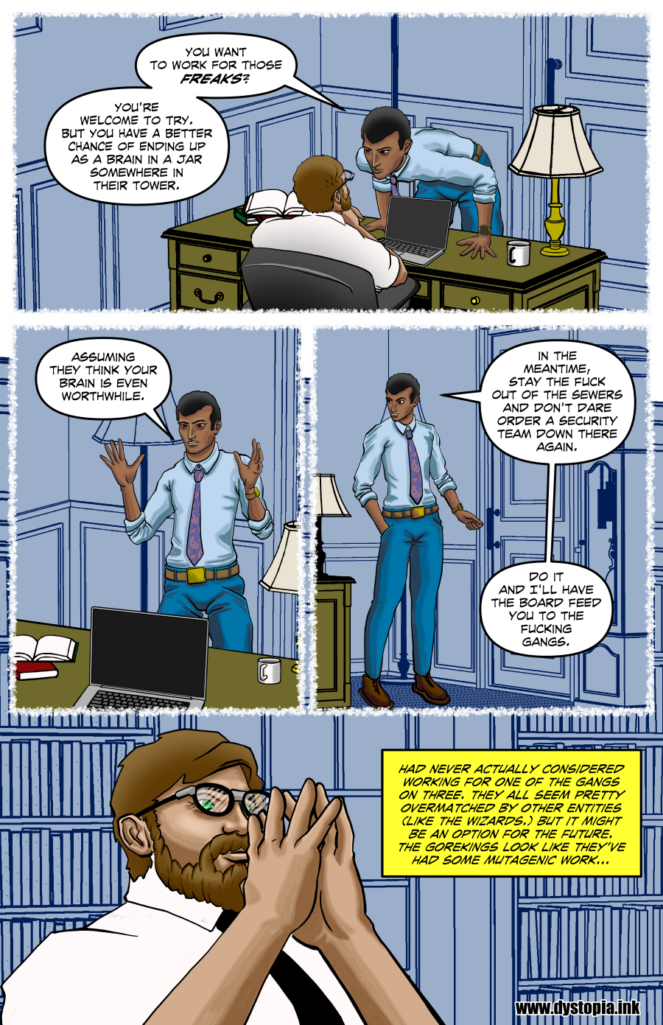
Scylla page five escalates the confrontation between Ventrik and DeBarett, shifting from restrained debate to open hostility while maintaining the veneer of corporate control. In the opening panel, DeBarett leans aggressively across his desk toward Ventrik, bracing himself with both hands as he questions whether Ventrik truly wants to work for “those freaks,” warning that attempting to do so would likely result in Ventrik being a "brain in a jar" somewhere in Iron Wizards' tower. Ventrik remains seated and composed, absorbing the threat without visible reaction.

The next panel shows DeBarett straightening up and spreading his hands dismissively, adding that such an outcome would only happen if anyone even considered Ventrik’s mind worthwhile. In the following panel, DeBarett turns away, posture rigid with authority, issuing a sharp order as he prepares to leave the office: Ventrik is to stay out of the sewers and is not to deploy another security team below ground. He reinforces the threat by stating that disobedience will result in the board cutting off Ventrik’s protection and feeding him to the gangs.

The final panel focuses on Ventrik, hands clasped near his face in quiet contemplation rather than fear. A caption reveals his internal thoughts: he admits he had never seriously considered working for one of the gangs on Level Three, viewing them as largely overmatched by larger powers like the Wizards, but now considers the possibility worth noting, especially given rumors that the Gorekings may have already experimented with mutagenic work. The page ends with Ventrik calm, calculating, and already looking beyond the boundaries DeBarett believes he controls.

Chapter 03: Scylla – Page 05

Working on these pages of Scylla has put me in a reflective headspace I didn’t entirely expect.

On the surface, the last few pages have been about power, hierarchy, and threat… quiet conversations in corporate offices, measured words that carry very real consequences, and characters who believe they’re justified in how they treat one another because of position, intelligence, or survival. But sitting with the finished pages, what really stands out to me is how casually cruelty can be delivered when it’s wrapped in authority or convenience. DeBarett remains composed and Ventrik doesn't show fear. And yet the way they talk to each other, and about other people, is sharp, transactional, and dismissive in a way that feels uncomfortably familiar.

In the midst of the Christmas season, a time that’s supposed to center generosity, patience, and care it’s hard not to think about how easy it is to forget those values when systems, deadlines, or perceived importance get in the way. Dystopia is a dark world by design, but the questions it raises aren’t limited to fiction: how we speak to others, who we deem “useful,” and how much empathy we’re willing to extend when no one is watching.

As always, Jackwraith and I are grateful you’re here reading along, thinking about these things with us, and I hope the season gives you moments of kindness, reflection, and connection both on and off the page.